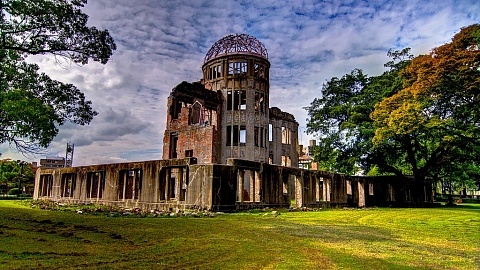
Chris Miller looks into issues surrounding the nuclear weapons debate and whether we should talk about "disarmament" or "abolition."


Once again, history seems to be repeating itself in the Middle East. In a previous article in Cicero, I pointed out the parallels between the anti-Islamist, status-quo axis between Saudi Arabia, the United Arab Emirates, and Egypt, and the post-Napoleonic “Holy Alliance” between Czarist Russia, Hapsburg Austria, and Prussia. Echoes have again arisen on the borders of this Middle Eastern Alliance. Yemen, never a particularly strong or coherent country, has recently collapsed into civil war, with Iran-backed Houthi rebels working in tandem with forces loyal to former president Ali Abdullah Saleh to seize control of much of the country.
These events have set off alarm bells ringing throughout the region. Several regional powers, led by Saudi Arabia and Egypt, have begun airstrikes on Houthi targets, with a ground intervention likely to follow. Of course, this is not the first time an internal struggle in Yemen has drawn in outside forces. In the 1960s, a civil war erupted between the royalist/religious state that had ruled Yemen under British and Saudi protection for decades and the republican Yemen Arab Republic, under the leadership of military officer Abdullah al-Sallal. Then as now, the internal strife threatened the national interests of the region’s big players, and attracted considerable outside aid. Most notably, Gamal Abdel Nasser’s Egypt sent a large expeditionary force to support the republican forces, numbering as high as 70,000 men at one point. Considering that current President Abdel Fattah al-Sisi, who has sought to claim Nasser’s mantle, may soon send troops back to Yemen, the case is worth examining more closely.
War Then and Now
The first thing to consider is the political situation for the key players at the time. In Egypt President Nasser was at the height of his power, but was also in need of a dramatic success. His vaunted project of Arab unity had recently crumbled under its own weight with Syria’s secession from the United Arab Republic, a political union with Egypt. He had staked so much of his reputation and rhetoric on the promotion of Arab brotherhood, and the collapse of the UAR made him look weak. With the outbreak of civil war in Yemen in 1962, Nasser saw his chance to win a short, sharp victory against reactionary forces and reestablish Egypt as the vanguard of republicanism and change in the region. Egyptian troops flowed forth.
Across the Red Sea, Saudi Arabia viewed matters rather differently. Accustomed to working with and exercising influence through the old rulers of Yemen, the Saudis strongly supported them with funding and weapons. With the two titans of the Sunni world backing opposite sides the war quickly turned into a stalemate, and over the years increasingly bled Egypt white. Although Nasser maintained troops there until after his country’s defeat in the 1967 Six-Day War with Israel, the conflict cost him and Egypt dearly in men, money, and prestige, and later would be remembered as “Egypt’s Vietnam.”
Although the proximate cause of the violence is different, we once again have dueling forces claiming legitimacy and the right to govern the Arab world’s poorest country.
As the gears of war turn faster in Yemen and an Arab ground intervention looks more and more likely, both similarities and differences can be seen with the 1962 conflict. Although the proximate cause of the violence is different, we once again have dueling forces claiming legitimacy and the right to govern the Arab world’s poorest country. We also have a very similar political situation in Egypt – as mentioned above, President al-Sisi has taken pains to take up Nasser’s mantle, and his actions both at home and abroad fit very much in the republican-nationalist mold. In addition, al-Sisi faces considerable pressure to distract his citizens from their domestic troubles by taking a muscular approach to foreign and security policy. And just as before, the relatively small-scale violence in Yemen is enough to trigger a response from most of the key regional players. Without a doubt, there are clear parallels between 1962 and 2015.
However, there is one important difference: In the first Yemeni civil war, Egypt and Saudi Arabia supported opposing factions, contributing to a stalemate by backing their proxies to the hilt. This time, the Saudis have assembled an impressive coalition that includes Egypt and virtually every other actor of consequence in the Arab World, including Jordan, the United Arab Emirates, Qatar, Kuwait, and Morocco. Although the Houthis do have an external backer in Iran, leaders in Tehran have rightly deemed overt aid too politically explosive at this time. The comparative Arab unity behind the internationally recognized government of Yemen has facilitated airstrikes and preparations for a ground intervention, this time with active Egyptian help.
Looking Ahead
With Saudi jets pounding targets inside Yemen and a joint flotilla working to secure the country’s ports, the differences between Yemen today and Yemen in 1962 will shape what follows. Egypt and Saudi Arabia are no longer working at cross-purposes. On the contrary, both are strong supporters of the status quo ante and will likely take all necessary steps to put the Houthis back in their box. More importantly, Riyadh will use its massive financial resources to bankroll Cairo’s military efforts, preventing the worst of the economic effects Egypt suffered last time. All things considered, it is very likely that the two countries, backed by other Middle Eastern states and their American patron, will eventually succeed in their efforts to restore Yemen’s fallen government to power.
Yet, all is not rosy for Saudi Arabia and Egypt. No matter the outcome in Yemen, an intervention will take time and prove very costly, even with the cushion provided by Saudi oil money. With the collapse of the price of crude from highs of $116 a barrel to around $56 as of this writing, sharp limits have been placed on the size of Riyadh’s reserves. Although there is no danger of serious financial strain in the short term, Cairo and Riyadh may very well be embarking on a years-long commitment to policing Yemen’s cities and ports, with no ceiling on expenditure. In addition, the potential for blowback remains – either in the form of renewed conflict down the road or political costs if the Yemeni venture is perceived to be a failure at home. Despite the best efforts of Saudi and Egyptian leaders, the ghosts of 1962 may yet haunt those fighting in 2015.
[Photo source: Flickr Creative Commons]


Chris Miller looks into issues surrounding the nuclear weapons debate and whether we should talk about "disarmament" or "abolition."
Air Force Captain Brad DeWees looks at Niccolò Machiavelli's "The Prince" and explores what lessons we can take from it for military innovation.
Felix Imonti argues that IS's main concern should be how they are to economically prop-up their Caliphate, instead of the bombs being dropped on them.


Arnold Isaacs reviews #VietThanhNguyen's book on how the #VietnamWar and its spillover conflicts are remembered ciceromagazine.com/r…


