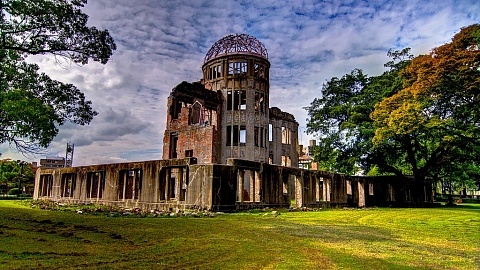
Chris Miller looks into issues surrounding the nuclear weapons debate and whether we should talk about "disarmament" or "abolition."


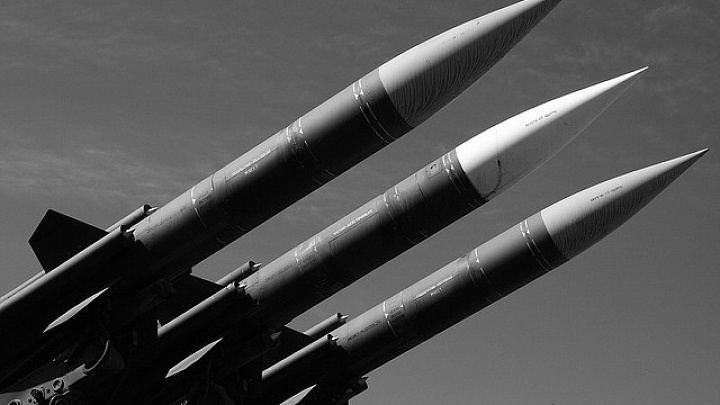
National Intelligence Estimates (NIEs) summarize the collective wisdom of the U.S. Intelligence Community (IC) regarding the situation in a foreign state or region or a particular international event. The IC consists of all of the agencies of the U.S. government responsible for collecting and producing national security information. It is produced at the direction of the Director of Central Intelligence or, since 2005, the Director of National Intelligence. NIEs convey an estimate of the situation to the President and high-level government officials and are used to develop national security policy. They may predict specific outcomes, provide detailed analysis of a foreign leader or international events, and/or analyse the economic or military capabilities of other states. They may make short or long-term predictions and/or may rank the likelihood of certain outcomes.
The process of developing NIEs is secret, but has been described by Sherman Kent as a report being put through an “estimating machine.” The form of the estimate is developed and the situation is thoroughly researched. All agencies of the IC collate available intelligence from all sources, a process involving thousands of people in multiple intelligence agencies. Related intelligence goes through a process of “evaluation, analysis and digestion.” A draft is developed and edited by an IC inter-agency board. The draft is then run through several ‘stations’ to appraise it. Finally, it is sent for approval to the National Intelligence Board before being distributed. NIEs are among the most important products the U.S. IC produces.
Though wrong, SNIE 85-3-62 is a vital document in international history relating to a time when the world stood closer to the brink of nuclear war than ever before or since.
The Context
SNIE 85-3-62 was part of a series of four NIEs prepared for President John F. Kennedy and his “EXCOMM” national security advisors, including as Defence Secretary Robert McNamara, National Security Adviser McGeorge Bundy, and the Joint Chiefs of Staff, among others. It dealt with events surrounding the 1962 Soviet military build-up in preparation for the stationing of Soviet nuclear weapons on Cuba—the Cuban Missile Crisis—and the relationship between the governments of Cuba and the USSR.
The first estimate of January 1962 (80-3) considered there were high prospects over the next 20 years of Castro spreading communism in the Caribbean, but it was unlikely the USSR would develop a major base there. Another estimate (NIE 85-62) two months later continued to emphasize the unlikelihood Moscow would build a major installation on Cuba as the USSR had thus far avoided giving Castro specific security guarantees and believed Moscow would not intervene to defend Cuba against any U.S. action. A third estimate in August (NIE 85-2-62) indicated a change in tone as new intelligence showed a build-up of Soviet military forces, but held these forces were just advisers, maintained that the USSR made no security commitment to Cuba, and Soviet forces were not there for offensive purposes. This was the IC’s estimate in summer 1962.
SNIE 85-3-62
Growing intelligence on the military build-up in Cuba in July and August 1962 changed the situation. The title of SNIE 85-3-62, released in September 1962, is “The Military Build-up in Cuba”, indicating recognition of the changing nature of the situation. “The Problem”, as the estimate states, is, “To assess strategic and political significance of the recent military build-up in Cuba and of the possible future development of additional military capabilities there.” This exhibits how the IC view of the forces on Cuba changed compared with the three previous NIEs—these forces were more than Soviet advisers; they were a defense force.
The SNIE reached five conclusions: The first (paragraph A) was that the build-up was intended to shore-up Cuba to deter U.S. invasion, though Moscow recognized installing an offensive capability risked confrontation with the U.S; second (paragraph B), the build-up was focused on anti-air and shore defense capacity to secure the regime, emboldening Castro to spread communism in the region; third (paragraph C), it recognized the possibility Moscow may deploy offensive forces on Cuba if it considered America won’t react militarily; fourth (paragraph E), it estimated South American governments would fear the intrusion of the USSR and expect the U.S. to respond to the situation without getting involved themselves.
The fifth historically key conclusion (paragraph D) was that, though the Soviets could obtain strategic advantage by stationing nuclear weapons on Cuba, it considered doing so would be inconsistent with Soviet policy to that point. The IC considered placing atomic weapons on Cuba would be a greater risk than Moscow had yet taken. Doing so would signal a major shift in USSR policy.
History
As history shows, SNIE 85-3-62 was wrong. Khrushchev did station nuclear weapons on Cuba, triggering the Cuban Missile Crisis of October 1962 and contradicting IC estimates, especially paragraph D of the SNIE. Academics continue to debate whether the SNIE is an example of ‘intelligence failure’.
Amy Zegart calls it a failure and points to evidence that the NIE process discounted evidence indicating a shift in Soviet policy had occurred, making the stationing of nuclear weapon on Cuba a more likely possibility. Although the crisis ultimately had a successful outcome for the U.S. and the IC performed well as a whole, she considers the SNIE an intelligence failure because it failed to anticipate the threat despite the evidence.
Sherman Kent, then-Director of the Office of National Estimates at CIA which developed the SNIE, defended its conclusions. He essentially argued that “estimates are estimates” and the conclusions were correct based upon the intelligence available at the time the SNIE was written. If the IC knew everything, especially ‘indisputable facts’, there would be no need for an estimate and a report of those facts would suffice. As it stood, Kent argued that, as indicated in the SNIE, Khrushchev’s decision to station nuclear weapons on Cuba was a major “zig” from Soviet policy to that point. Lacking “indisputable facts” showing a new course was being taken, the estimate leaned on previous Soviet policy. Kent considered that though the estimate was ultimately wrong, it was correct given information at the time.
In any case, SNIE 85-3-62 exhibits the importance of NIEs to U.S. decision-makers such as the President and his national security advisers. The U.S. posture toward Cuba prior to the missile crisis was based upon the estimates in this and preceding Cuba NIEs. It also shows the result of intelligence gaps. In the absence of “indisputable facts,” a “best guess” must be made. NIEs are that best guess. Though wrong, SNIE 85-3-62 is a vital document in international history relating to a time when the world stood closer to the brink of nuclear war than ever before or since.
 Chris Miller is a U.S. Army veteran and Purple Heart recipient following two tours in Baghdad, Iraq and has worked as a military contractor in the Middle East. His work currently focuses on strategic studies. His interests are CBRN, military and veterans issues, the Cold War, and international security affairs.
[Photos: Flickr creative commons]


Chris Miller looks into issues surrounding the nuclear weapons debate and whether we should talk about "disarmament" or "abolition."
Air Force Captain Brad DeWees looks at Niccolò Machiavelli's "The Prince" and explores what lessons we can take from it for military innovation.
Felix Imonti argues that IS's main concern should be how they are to economically prop-up their Caliphate, instead of the bombs being dropped on them.


Arnold Isaacs reviews #VietThanhNguyen's book on how the #VietnamWar and its spillover conflicts are remembered ciceromagazine.com/r…


