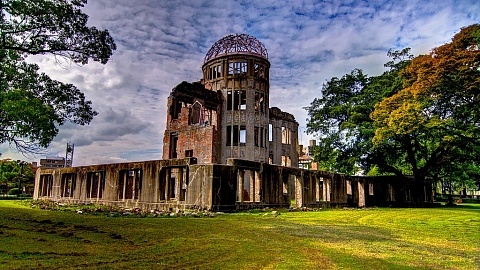
Chris Miller looks into issues surrounding the nuclear weapons debate and whether we should talk about "disarmament" or "abolition."


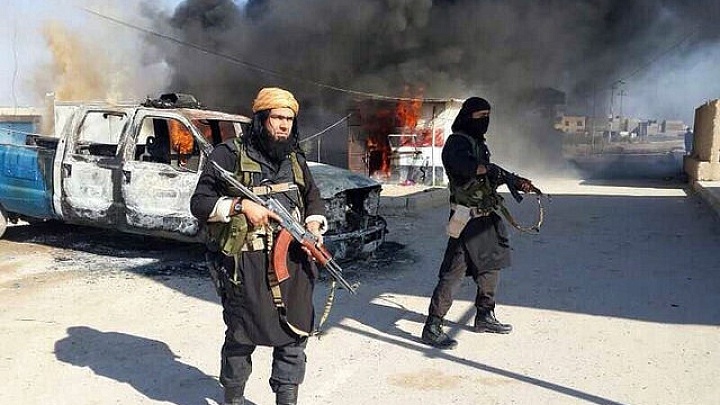
ISIS now controls a vast swath of territory the size of Jordan. Control of this land might pose a threat to counterinsurgency efforts, but it may prove to be an even bigger problem for the insurgency itself. While controlling territory sounds like an immediate advantage for an ambitious militant organization, it brings with it an array of unique difficulties for an insurgent movement like ISIS, not least of which is a geographic, stationary target for its enemies.
In a Journal of Conflict Resolution study by Luis de la Calle and Ignacio Sanchez-Cuenca the authors looked at 75 insurgencies around the globe that were active between 1970 and 1997, analyzing territorial versus non-territorial conflicts. What they found was not especially unpredictable: Insurgents that gain, combat, and control territory are comparatively more lethal than those that do not, and insurgents are more likely to seize territory if the pre-existing state has a low per-capita GDP (economically weak) and resorts to a more dictatorial form of government. Controlling territory, from a military and political perspective, provides a uniquely attainable degree of legitimacy and lethality.
It is easy to see why ISIS so easily pursued its territorial ambitions. A feeble government and frail Iraqi military, combined with a poor economic outlook as the U.S. and others shift their energy dependencies elsewhere, formed a prime opportunity for ISIS to strike. Moreover, the control of territory is often a recruitment tool and barometer of an insurgent group’s effectiveness. This desire to command and control territory, however, is not without its risks. First, territorial control is a costly business. ISIS has been called the “richest terrorist organization in the world”, with money flowing from its control of oil resources, extortion, kidnapping, and from private donors in Saudi Arabia and other gulf states. This money, however, has attracted a slew of international scrutiny. Other Arab states, pouring money to opposition groups in Syria, have been accused of funding the ISIS surge in Iraq. Such exposure makes it difficult for the insurgency to continue its funding methods, and puts their future effectiveness at a long-run risk. Donors, organizations, and foreign nations that were previously contributing—directly or indirectly— to ISIS may not be so bold under the scrutiny of the international eye.
While owning and controlling territory allows for a greater degree of centrality and organization, a geographical stronghold provides a clear and present target for international military reaction. Recent developments in Iraq have highlighted the significance of geographic hotspots. Mount Sinjar, a stronghold for thousands of Yazidis, came under attack last week as Islamic State forces threatened extermination of the local population, prompting a U.S. military response. With a specific geographic region to target, American forces have been able to carry out targeted airstrikes to effectively suppress Islamic State movement. Likewise, Kurdish forces reclaimed the towns of Makhmour and al-Gweir from ISIS control.
Then there is the problem of governing territories. Maintaining control of seized territory is a tremendous undertaking for an insurgent group that has selected extreme violence as its method of coercion. In supplanting al-Maliki’s government, ISIS leadership must implement a detailed infrastructure to provide its “citizens” with a functioning form of governance. Tax collection, municipal maintenance, education, social support, medical services, and utilities just begin to scratch the surface. Not only are these endeavors costly, adoption by local inhabitants may prove challenging for a militant group intent on imposing harsh shari’a law and whose media headlines include stories of mass execution and torture. This degree of successful governance is not impossible, however, as Vassar’s Zachariah Cherian Mampilly highlights in his book, Rebel Rulers.
Control of territory is often a useful recruitment tool and barometer of an insurgent group’s effectiveness.
Indeed, ISIS has had some degree of success in Mosul, which it seized on June 8th. In a report from the Institute for the Study of War, Mosul’s Sunni majority has eased the transition from Iraqi control to Islamic State control, with inhabitants participating in ISIS-led parades and functions, and local tribal groups showing willingness to cooperate and assist in the development of new leadership. These gains are not without strong indicators of weakness, however. ISIS militants are still relying heavily on scare-tactics, kidnapping, extortion, and targeted assassinations against wealthy inhabitants who show resistance. Additionally, according to the same report, the Islamic State has implemented heavy fines against Christian families in Mosul, threatening execution should there be lack of cooperation.
The coming months will be pivotal for both sides of the conflict. While ISIS continues its push toward Baghdad, its early success has prompted an international military response. In order to further its legitimacy beyond the confines of a militant insurgency, ISIS must command and control the Levant to wield any real geopolitical authority. This territorial control, however, may very well be its downfall. A continued U.S. military effort has already boosted Peshmerga resistance, and the international community is beginning to join the United States to form a unified coalition, with the UK ramping up its military involvement in Iraq and Australia considering committing air and ground support. Al-Baghdadi may have found relative ease in taking Mosul, but as rebel groups that have grabbed territory going back centuries have found, being a “roving bandit” is often easier than being a stationary one.
Jordan Bravin is an undergraduate at Yale University, an NROTC Midshipman, and an editorial intern with Cicero Magazine. His opinions and comments are the author’s own, and not endorsed, supported, or verified by the Department of Defense, Department of the Navy, or any other association.


Jordan Bravin is an undergraduate at Yale University, an NROTC Midshipman, and an editorial intern with Cicero Magazine. His opinions and comments are the author’s own, and not endorsed, supported, or verified by the Department of Defense, Department of the Navy, or any other association.
Chris Miller looks into issues surrounding the nuclear weapons debate and whether we should talk about "disarmament" or "abolition."
Air Force Captain Brad DeWees looks at Niccolò Machiavelli's "The Prince" and explores what lessons we can take from it for military innovation.
Felix Imonti argues that IS's main concern should be how they are to economically prop-up their Caliphate, instead of the bombs being dropped on them.


Arnold Isaacs reviews #VietThanhNguyen's book on how the #VietnamWar and its spillover conflicts are remembered ciceromagazine.com/r…


