
Bridget Coggins on her new book, Power Politics and State Formation in the Twentieth Century, on how states come to be in the modern world.


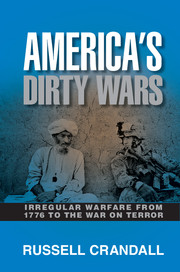 America’s Dirty Wars: Irregular Warfare from 1776 to the War on Terror
By Russell Crandall
Cambridge University Press, 598 pages, $35
This book examines the long, complex experience of American involvement in irregular warfare. It begins with the American Revolution in 1776 and chronicles big and small irregular wars for the next two and a half centuries. What is readily apparent in dirty wars is that failure is painfully tangible while success is often amorphous. Successfully fighting these wars often entails striking a critical balance between military victory and politics. America’s status as a democracy only serves to make fighting - and, to a greater degree, winning - these irregular wars even harder. Rather than futilely insisting that Americans should not or cannot fight this kind of irregular war, Russell Crandall argues that we would be better served by considering how we can do so as cleanly and effectively as possible.
Your book seems to defy conventional wisdom, which says that the US can’t get down and dirty and defeat insurgencies. Look at our current setback in Iraq. How does your book address these criticisms?
The 200-year historical precedent is certainly replete with irregular wars that the United States has gotten down and dirty in and not defeated insurgencies. And these tend to be the ones that we remember and apply to current and future cases. But it’s not the whole history of America’s dirty wars.
For me dirty wars are the same thing as irregular warfare—all the things that regular war is not.
How much of the problem is the lack of political or popular will for Vietnam-style counterinsurgencies, versus one of force posture or the mentality of our military/armed forces, which seems more enthralled and better suited to fight conventional wars?
This might sound evasive, but I think the key element in any particular case of American involvement is that “it all depends”. Political will and popular support can certainly help America prosecute these types of wars but the ongoing case of Afghanistan shows that this alone does not ensure success. It is fascinating to see how episodic the U.S. military understanding and embrace of irregular warfare has been over two centuries. The default has been that these dirty wars are aberrations that the military will fight only if it must. Following Iraq the new COIN philosophy assumed that the murky realm of irregular warfare would be the default conflict and was thereby embraced. But now a new sobriety is questioning this fidelity. What this suggests is how either knowingly or otherwise recent events weigh on our understanding of the past, present, and future. If Iraq and Afghanistan had been the cakewalks they appeared to be in their initial phases, our understanding of America’s ability to influence irregular warfare would be decidedly different. Yet the difference between cakewalk and quagmire in these two cases was remarkably thin.
The expression “dirty wars” has become synonymous with our controversial and what human rights groups could say are illegal actions against suspected terrorists – whether through the use of drones or commando raids—here I’m thinking of Jeremy Scahill’s recent reporting on this subject. Is this a correct picture of how America fights these wars?
For me dirty wars are the same thing as irregular warfare—all the things that regular war is not. So this includes guerrilla warfare, counterinsurgency, and everything in between. It’s also apparent that these wars come in all shapes and sizes. I label the type of dirty wars addressed in Jeremy Scahill’s work “post-modern” dirty wars as they have many of the same attributes and moral questions associated with irregular warfare but in this entirely new technological format.
Take us back through a “dirty war” the U.S. fought and won successfully.
A more recent case is Colombia over the past fifteen years. And much of what the U.S. did in Colombia— and there was a lot that didn’t work—came from the lessons gleaned from the experiences in El Salvador in the 1980s. But these “successful” cases are in fact two where the American role was largely through local proxy. That is, Washington did more with less. What we also see is that Salvador might have fit Colombia, but then exporting the Colombia model to Mexico’s narco-wars in recent years did not work as expected. Needless to say, the details matter tremendously. Yet, practitioners are always looking for the magic bullet model. COIN worked in Iraq so we know how to win in Afghanistan.
What are ways in which we can fight these wars in a cleaner or, as some would say, less violent or legally dubious fashion?
It goes without saying that all wars—regular or otherwise—are dirty. But the very nature of dirty wars makes them especially prone to abuses. The historical record shows that America has sometimes fought these wars cleanly and other times less so. Again, much of the attention focuses on the latter for understandable reasons. But all cases should be considered in trying to get a sense of how the United States has acted in the past—and moving forward. Part of the problem with trying to fight every dirty war “cleanly” is that we of course often don’t pick the way of fighting these wars. And as they say, if you lie down with mangy dogs you’ll stand up with fleas. And herein lies the dilemma of America’s experience with irregular warfare—its very nature ensures that it will be controversial, poorly understood, and at times, yes, dirty. And we will win some and lose some. That’s why in each particular case it is vital to be considerate of how we can do so as cleanly as possible.
You describe such campaigns of “irregular warfare” as an “inescapable reality.” Why? Why won’t the future of 21st century warfare be fought through conventional means between states?
America’s dominant global strategic position—and our demonstrated willingness to use military force in a variety of scenarios— ensures that we will continue to have our fair share of dirty wars. But again this is not linear or really at all predictable. Take our current era of restraint under President Obama. To play a counter-factual, maybe if Iraq had turned out more successfully we would have then had more positive evidence to back a more maximalist response to waging a dirty war in Syria. That of course did not happen and we have attempted to do dirty war-light in Syria. And this approach is indicative of something else I highlight in the book—that each dirty war in unique and inherently tied to the particular zeitgeist of the day. So if the Indian Wars were tied to Manifest Destiny and Vietnam was about containment and Afghanistan and Iraq about 9/11, then maybe Obama’s dirty wars—including the post-modern drones and commando strikes—reflect this new restraint.
Fred Kaplan and others point to some of the logical incoherence in America’s COIN doctrine adopted in 2006, namely that state building by definition requires some use of kinetic force, which might go against some of the touchy-feely stuff of winning hearts and minds and clearing and holding territory and so forth. Are the two mutually exclusive? How can we improve upon the COIN literature of the late 2000s?
I think Kaplan might be on to something in that the new COIN doctrine was packaged in such an intellectually and politically palatable way that in reading it you might think that you could win a big counterinsurgency war without killing anyone—or even fire a shot. But let’s not forget where COIN was coming from back in 2006. We had somehow forgotten our T.S. Lawrence and David Galula at our own peril and the COIN revolution corrected that. It might be one of those pendulum swings. COIN maximalism swelled after the Iraq “surge” but now we’ve shifted back after we didn’t see the repeat performance in Afghanistan. What my book tries to do is to put these micro trends, ideas, and episodes into the broader context. It is likely that our understanding of the role that COIN doctrine did or did not play in the history of America’s dirty wars will shift greatly depending on how our current and future conflicts turn out.
What are some things that scholarship could do better to enlighten our empirical understanding of such civil or dirty wars?
Ah, my favorite question of the batch! My first plea to scholars and students is that we first know the history. I’m amazed at how much of the American experience in irregular warfare is either not known or misunderstood. And this is often with cases with the relative successes. Does anyone remember the U.S. campaign in the Philippines after 9/11? We would have had four thousand Americans died there. Just because they did not does not mean that this is not a salient lesson from our canon.
 Russell Crandall is a professor of international politics and American foreign policy at Davidson College. His previous books include ‘The United States and Latin America after the Cold War’, ‘Gunboat Democracy: U.S. Interventions in the Dominican Republic, Grenada, and Panama’, and ‘Driven by Drugs: U.S. Policy toward Colombia’. He has also held several high-level foreign policy appointments with the Joint Chiefs of Staff, the Office of Secretary of Defense, and the National Security Council


Bridget Coggins on her new book, Power Politics and State Formation in the Twentieth Century, on how states come to be in the modern world.
Nicolaus Mills on his book, Every Army Man is With You, and the story of the 1964 Army football team that defeated Navy, but went on to fight less certain and...
Jeff Bridoux, co-author of a new book on Democracy Promotion, discusses this controversial concept in the post-9/11 era following George W. Bush's 'Freedom...


