


Latest:   

It Takes A Massacre to Save a Village

September 7, 2014 at 2:24 am  •  1 Comment

By

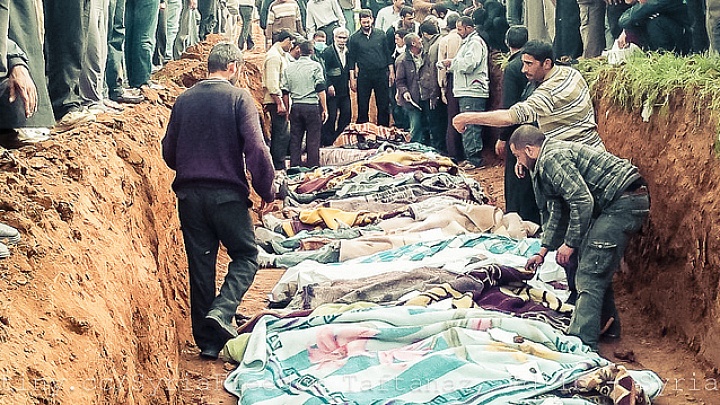
The gruesome images of American captives being beheaded by ISIS militants made front-page news. But the war in Syria has produced so many grisly images, I worry that our consciences can no longer be shocked.

To those like me who ponder what it would take to get our government to intervene for humanitarian reasons with force – having stood by idly last summer as an entire neighborhood of Damascus was gassed to death and an airplane full of passengers was shot out of the sky earlier this summer – I wonder if the culprit is our collective numbness to human suffering. Or maybe it’s the shrewdness of our enemies to creep up to the line of carrying out massacres without ever crossing over it. A case could be made that unlike, say, in the Balkans or Libya, there has been no “action-forcing event” in Syria.

But then thousands of Yazidi besieged on Mount Sinjar faced potential genocide at the hands of Islamist fighters and, lo and behold, we pounced. What 190,000 dead in Syria could not accomplish, the sheer act of preventing a pending massacre could. A similar explanation – to presumably avoid a bloodbath in Benghazi – informed NATO’s intervention in Libya. So maybe the lesson is: It takes a massacre to save a village?

Humanitarian interventions have long followed massacres, though in the past the victims were often Christians at the hands of non-Christians living “beyond the pale.” A massacre captures our collective attention on an issue (gun control) or a conflict (Syria’s civil war), even though we are not present, like no plea or petition can. It is the haunting memory of a rerun of such an event that propels otherwise stubborn politicians into action. Americans, however fleeting, are motivated by a “never again” ethos after such tragedies.

Take the massacre of 20 schoolchildren in Newtown, CT, which shook the national conscience and pushed Congress to finally debate – yet fail to pass any – sensible gun legislation. The real tragedy of such massacres is that the slow trickle of everyday gun violence, whether in urban neighborhoods on in war zones, goes untreated and uncovered. Only remarkable one-off events register these days.

We are creatures of habit. The preferred course of those uninvolved is to stand aside, or to look away. We have selective attention spans and short-term memories – a lethal combo for a country like ours asked to save the world.

The perpetrators are inevitably portrayed as “barbarous” or “sick,” not the work of rational or local actors. But this kind of reactive policy is neither rational nor reasonable, whether in response to a bout of mass violence on the street or to a civil war. A catch-22 of any massacre – whether a school shooting or campaign of genocide – is that its mere existence is evidence that more should have been done sooner. All massacres are preventable.

Several massacres have resulted from just bad policies. Arguably the massacres by ISIS rebels in Iraq could have been avoided had we not invaded Iraq in the first place (say liberals), or had we not pulled forces out so precipitously (say conservatives). Likewise, Newtown was a result of nonsensical gun laws. Srebrenica was a direct result of a flawed UN policy of creating so-called “safe havens,” that were neither safe nor havens. In many instances, such as in Rwanda, it’s often too little, too late. The same goes for 19th century interventions, which failed to prevent massacres. “European powers intervened too late, with too few troops and means or both,” writes Davide Rodogno in Against Massacre, citing examples in Greece, Lebanon, and Armenia.

Of course we know from recent history that a massacre does not always trigger a public outcry. A massacre is not just about quantity – there is also a qualitative component to it that matters. The Newtown massacre sparked more outrage than the Aurora, CO shootings because the victims were mostly innocent schoolchildren. Ditto the shooting in Ferguson, MO has triggered public outrage because of its racial component.

How we respond also matters. If President Obama had rammed through gun-control decrees in the wake of Newtown, it likely would have faced stiff resistance, and may have sparked mutinies across rural America. Similarly, if we were to unilaterally intervene in Ukraine to staunch the violence there, our legitimacy may be called into question. The most effective interventions are carried out in a collective fashion. This goes back to the 19th century Concert of Europe.

Don’t Europeans want those who committed this barbaric act, the downing of the Malaysian airliner, brought to justice? Or do they brush it off as an accident, a tragedy due to the fog of war, not to malice on the part of any rebel commander or Russian president. Maybe the world has just gotten better at forgiving, not just forgetting.

We are creatures of habit. The preferred course of those uninvolved is to stand aside, or to look away. We have selective attention spans and short-term memories – a lethal combo for a country like ours asked to save the world. We care about Joseph Kony one day, then forget about child soldiers in Uganda the next. We are galvanized by Boko Haram’s abduction of hundreds of schoolgirls and “bring our girls back” becomes a Paul Revere-like rallying cry. Yet most Americans have since forgotten about Boko Haram. When everything is a game-changer, nothing is a game-changer.

Even the downing of a civilian passenger airliner and the inexplicable deaths of 300 innocent passengers has faded from our collective memories. How are Europeans, especially the Dutch, not madder? Don’t they want those who committed this barbaric act brought to justice? Or do they brush it off as an accident, a tragedy due to the fog of war, not to malice on the part of any rebel commander or Russian president. Maybe the world has just gotten better at forgiving, not just forgetting.

Maybe, like the helpless doctor seen as cold-hearted to a dying patient, we are just becoming more aware of our own tragic inability to respond effectively. Maybe we are not growing more immune to suffering or to atrocities that shock the conscience but rather just realize that the cost of action with each new atrocity has increased.

Even as the Newtown shootings pushed America to finally confront its addiction to guns, nothing came of it. No such action-forcing event has occurred yet in Syria, not even the use of chemical weapons – after all, Americans knew that Saddam had gassed thousands of Kurds in Halabja in 1988 but did nothing. For civil wars, only a signal of a pending genocide raises the bar high enough to prompt an outside intervention. But dictators, terrorists, and gang leaders know that. So the lesson for Putin and Assad is clear: Kill slowly enough and you will be left alone.

Now ISIS has captured our collective imaginations – the image of an American journalist being beheaded replaying in our heads. The group may have overreached, having made the mistake of getting too close to Erbil and Baghdad, and threatening genocide of a persecuted minority. That was enough to trigger a U.S. intervention by air.

Yet, absent an action-forcing event –a massacre, a school shooting – we know that not much changes. We go about our business with backwards gun laws on the books. We go about ignoring Syria as the death count approaches 200,000. We ignore the steady drip-drip-drip of gang-related violence in places like South Chicago or Central America, until its kids show up at our border seeking asylum. Until it affects us directly. Even then, it is all we can do to look away.


[Photo: Flickr CC: Freedom House]


lionel


Lionel Beehner is formerly a senior staff writer at the website of the Council on Foreign Relations, where he was a term member. He is a member of USA Today’s Board of Contributors and is a PhD candidate at Yale, focusing on nonstate actors and the use of force.

FacebookTwitterGoogle+Print
About the Author

Lionel Beehner is formerly a senior writer and term member at the Council on Foreign Relations, and current PhD candidate at Yale University. He is the founder and co-editor of Cicero Magazine.

One Comment

  1. Mike M. / September 8, 2014 at 6:27 pm /Reply

    I’m not even sure where this article is trying to go, do you want to discuss changes in gun laws and related crimes that have occurred in this country or do you want to discuss international intervention either military or humanitarian assistance to situations like civilian deaths as the result of Civil War or Terrorism or outright genocide of a group of people?

    Those really are different topics and you cannot use our (US) action or not in one as a counter point to the other.

    I’m not even sure I want to get into a discussion on gun laws/ownership in this country and crimes as their often isn’t a direct correlation. Certainly not in the Connecticut school shooting example. That was a result of a massive failure by the parents, not get the proper care for their child. He clearly wasn’t stable and the family had issues, he could just as easily killed as many children with an axe or machete or even beaten them to death with a baseball bat or run a car into the building into the classroom. How it did it wasn’t the issue here, the fact of the matter is, that he should probably have been under supervised care of mental health professionals. The recent incident has in Missouri also not a gun law issue and certainly not a massacre and clearly as unrelated to the international incidents you mentioned as Ray Rice beating up his fiancée

    At any rate given the theme of this site, let’s look at the international incidents for a moment and as to why we may intervene or not.

    First and foremost, when you are talking about any country in Africa or the Middle East (ISIS is a separate issue which we’ll get to) or the rest of the world for that matter they are sovereign nations bound by international laws just as we are, so while it seems the US is viewed as the world’s police force by the media, we can’t simply unilaterally decide to intervene with military force every time there is a civil war or some other conflict going on. Syria is an example of this, who knew what was going on in the beginning in the International community let alone in the Intelligence Community? Depending on which side you believe Assad was relating against terrorist attacks against the government and military targets or it could have been construed as a civil war had given a small group of Syrians and defectors from the military attempted to form a new government (at least on the surface to get help from the international community). Yes it’s tragic that 10s of thousands of people have been killed and displaced in this conflict, but what do you propose the United States should do in this case? Assad was/is backed by the Russians and secretly by Iran. There has been no international (UN) consensus on what to do other than to impose sanctions, which are useless . So what should we do? We’re not going to side with Assad and his government and we which group that’s fighting him do we support? How do we know which one, wants to form a legitimate new government or separate country by splitting Syria or they are simply there to fight to carve out their own territory like ISIS?

    We don’t exactly have a great track record of nation building in the region and the internationally community doesn’t either. How long before the UN stepped in in Bosnia and oh look never in Africa in some cases.

    Sending humanitarian aid in the country while there is a conflict isn’t going to do a damn thing either and It’s up to Jordan, Turkey, Lebanon and Iraq as to whether or not they want to open their borders to refugees, if so we could certainly provide aid at that point, but that’s only going to help the people who can leave the country.

    If we take military action, we can’t pick sides. You would have to secure the entire country and have both sides lay down their arms and have the UN move in to provide security until a peace treaty could be reached and then decide what to do with the country just like we did with bosnia. It might end up being that Syria is split into two or 3 countries rather than trying to remain a whole and then how long would the UN need to remain in place to secure peace?

Leave a Reply

You may use these HTML tags and attributes: <a href="" title=""> <abbr title=""> <acronym title=""> <b> <blockquote cite=""> <cite> <code> <del datetime=""> <em> <i> <q cite=""> <strike> <strong>