

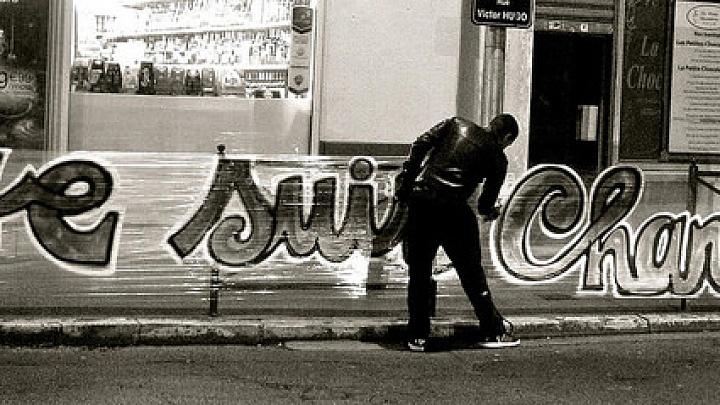
"Laws are silent in times of war."
Latest:   

On Charlie Hebdo, United We Fall?

January 12, 2015 at 12:27 pm  •  0 Comments

By

There has been an outpouring of social media solidarity with the journalists and cartoonists gunned down in their Paris offices. I received an email from one civil society group warning me I had 24 hours left to “stand with Paris.”

I found this frisson of Facebook solidarity welcoming on one hand, but quite strange, and at times, off-putting on the other. While we can all join forces against the barbaric nature of this act, there seems to be this assumption that unless we stand together as one, the terrorists who did this win.

That is absurd and a naïve reading of what terrorists seek. “This is just what the gunmen wanted: division and fear,” read an email alert from Avaaz (bold theirs). What if the terrorists were not thinking bigger picture, about dividing the West as it were, but just wanted two things: For the cartoonists and editors dead, and for future cartoonists or editors to think twice before publishing a likeness of the prophet? Then even if we all come together, it would seem in vain. Again, this is not to say that we should not unite, but uniting seems to mean we are all in agreement and that there is no room for moral equivalency or nuance when it comes to defending free speech. It’s also suspicious when even The Nation and FOX News are all on the same page on this hashtag campaign. Even Hezbollah’s Hassan Nasrallah appeared to denounce the killings.

Moreover, as Americans we must also look at our own awkward and uneven past at protecting freedom of speech. I keep hearing the playback loop of President Bush’s press secretary Ari Fleischer warning in 2001 that “all Americans that they need to watch what they say, watch what they do.” This exhortation was in response to the comedian Bill Maher using humor to editorialize about 9/11. Um, kind of what like Charlie Hebdo does on a weekly basis? I also vaguely recall an alternative newsweekly in New York featuring a story by Matt Taibbi titled “The 52 Funniest Things about the Upcoming Death of the Pope.” Senator Chuck Schumer called it “The most disgusting thing I’ve seen in 30 years of public life.” (Full disclosure: I worked as the newspaper’s research editor around the same time). Wait, what happened to free speech? What happened to Je suis Charlie?

Just as Le Monde declared “Nous sommes tous Américains,” the world has rallied behind “Je suis Charlie.” Then, as now, we could use more divisiveness in our discourse.

We are for free speech when it’s convenient, then lambast it or stifle it when it offends. True, we do not hijack editorial offices, but then again, terrorism like the kind we saw last week in Paris is a weapon of the weak. When other religions are offended by cartoonists or artists, they can stifle dissent thru less overt ways – by blacklisting, by ruining careers, by throwing money at problems to go away. I also can’t help worrying that we actually don’t want to live in a society where all kinds of speech are tolerated or supported – in Europe, you cannot deny the existence of the Holocaust. In the United States, we have laws on the books against hate speech. I cringe when I hear this nonsense that the cartoonists were equal-opportunity offenders. That is like saying that my Uncle Joe is not just a bigot, he’s also a homophobe and sexist, so come on, lighten up! The line between humor and hate speech is not fine – it is blurry. We might say the antics of Dieudonné M’Bala M’bala are hate speech, given its anti-Semitism, but his sell-out crowds might consider him a Muslim Bill Maher.

Distance from the issue and safety in numbers affords us a kind of detachment and short-term reflection. Like #Kony2012, #BringBackOurGirls, or #BlackLivesMatter, #JeSuisCharlie has gone viral and has seeped into our collective consciousness. But for what purpose? Yes, awareness has been raised - nobody had previously heard of Joseph Kony or Boko Haram, much less could place Ferguson, MO, on a map — but Facebook “likes” and even a million French marchers can only do so much. More dangerously, such solidarity provides a kind of cloak of legitimacy for those strange bedfellows marching who do harbor resentment toward Islam and take their revenge by, say, refusing to ride in taxis driven by French-Moroccans or worse. Finally, such hashtag campaigns can be harmful because they create the illusion of doing something about the problem, a point Malcolm Gladwell raised about social media as a weak form of collective action. Two thousand Nigerians, many of them women and children, were slaughtered last week by Boko Haram. This was as avoidable as the attack on Charlie Hebdo’s offices. Had there been a more concerted and tangible campaign of action back when the schoolgirls were abducted, including the full might of the U.S. or French militaries, we would not be discussing two thousand dead Nigerians as a sidebar story to 17 dead Frenchmen.

The Charlie Hebdo campaign reveals no shortage of hypocrisy in the West. After all, almost no newspapers published their most offensive cartoons at the time, and only a small handful would even dare publish them after the horrific events of last week. Just how we let a small handful of Americans do the dying for us in wars, we let an even smaller handful of cartoonists do the lampooning of sacred cows and defending of free speech which is so vital to our democracy. The gunmen do not want “division and fear” we’re told. My guess is they want us to overreact, much as Americans did after 9/11, by launching two unneccessary wars. That would be the biggest boon for them from a recruitment standpoint and feed into their us-versus-them narrative of the world. Just as Le Monde declared “Nous sommes tous Américains,” the West has blindly rallied behind “Je suis Charlie.”

Then, as now, we could have used more divisiveness.

FacebookTwitterGoogle+Print
About the Author

Lionel Beehner is formerly a senior writer and term member at the Council on Foreign Relations, and current PhD candidate at Yale University. He is the founder and co-editor of Cicero Magazine.


Leave a Reply