

"Laws are silent in times of war."
Latest:   

By

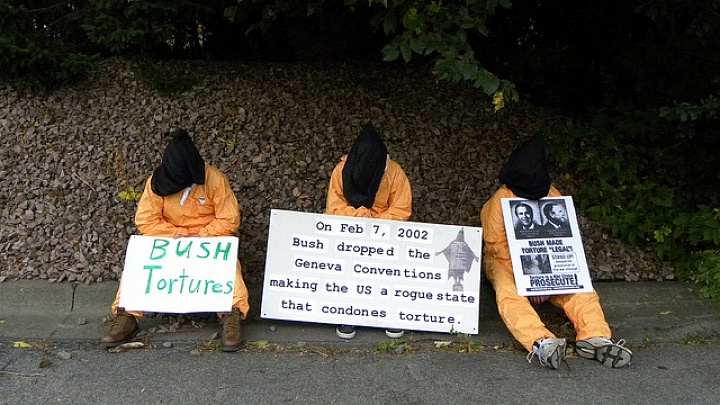
The controversial U.S. Senate report on the use of “Enhanced Interrogation Techniques” by the CIA has again stirred cries to prosecute members of the George W. Bush Administration for war crimes. Even if one is so inclined, the past performance of the International Criminal Court (ICC), other ad hoc war crimes tribunals, and the legal hurdles to be jumped in order to bring the architects of the enhanced interrogation program to international justice would be unlikely to produce any satisfying result any time soon. However, America’s own existing laws and justice system could provide a more viable route to justice and ensure that torture never again becomes official U.S. government policy.


Justice Delayed is Justice Denied

After the ad hoc tribunals for war crimes in Yugoslavia proved extremely costly and time consuming, the need for a permanent body dedicated to such prosecutions became clear. The ICC, formed in 2002, was born out of this need, yet has thus far only brought 28 cases to court and only one process has ever been completed. That is not a very impressive track record.

The United States is not a party to the ICC. The primary reason is the very real concern that U.S. military or civilian officials could be prosecuted before the ICC for war crimes as political acts of retribution rather than as genuine cases of crimes against humanity. The fear is that the ICC would become a stage on which international political grievances would be played out rather than a serious forum for international justice. Other nations—such as Israel—have voiced similar concerns.

This concern was also one of the key reasons President George W. Bush did not sign a Status of Forces Agreement with Iraq in the waning months of his second term. The Iraqi government refused to agree to grant immunity to U.S. troops and officials for their actions in Iraq. The administration was concerned that one day its soldiers and civil servants would be hauled before an international court and put on a show trial in a kangaroo court. The Bush Administration went even further against the concept and mission of the ICC by signing Bilateral Immunity Agreements with over 100 nations that were party to the ICC. These agreements guarantee the United States will never surrender a U.S. official or soldier to the ICC.

Federal prosecution…would send a clear message that America is serious about bringing those responsible to justice and ensuring torture will never be official U.S. government policy again.

The ICC has had its share of failures and, most recently, the high-profile case against Kenya’s President, Uhuru Kenyatta, collapsed. In 2012, Kenyatta became the first head of state to be brought before the ICC for crimes against humanity. In 2007 and 2008, 1,200 people were killed and 600,000 displaced in post-election violence. Mr. Kenyatta’s opponent, William Ruto, is also being charged in the ICC with crimes against humanity for the same episode of violence. Prosecutors in the case have repeatedly asked for more time to gather the necessary evidence. On December 3, 2014, ICC officials gave prosecutors a week to decide whether to pursue their case or withdraw charges, saying further delays would be “contrary to the interests of justice.” Two days later, after prosecutors admitted their case had, “not improved to such an extent that Mr. Kenyatta’s alleged criminal responsibility can be proven beyond reasonable doubt”, the case was dropped altogether.

This is only the most recent case the ICC has tried that was plagued by procedural delay and bureaucracy. The ICC’s track record is not very stunning. It has issued a total of 28 arrest warrants, eight summonses, and ordered the detention of seven persons. It has only completed proceedings against 13 individuals. Of these, only two were convicted. Five resulted in dismissals, two had charges withdrawn, one was declared inadmissible, and three were dropped when the individuals concerned died before trial. Not a very convincing record. Another notable fact is that all prosecutions brought before the ICC in the last 13 years have stemmed from events in Africa-not one in Europe, North America, Asia or elsewhere. The meaning of this fact is open to interpretation, but perhaps it shows that only those with governments too weak to shield them from the international community need fear prosecution before the ICC.

Though prosecution of U.S. officials before the ICC is a virtual impossibility, that is not the end of the matter. In 1994 the United States Senate ratified the United Nations Convention against Torture. This requires the U.S. prosecute perpetrators in cases of cruel, inhumane and degrading torture or punishment. This means that the United States has its own domestic legislation on the books under which it can very well prosecute the individuals who carried out torture and those who authorized it. Senator Dianne Feinstein (D-CA), Chair of the Senate Intelligence Committee, said she hoped release of the Senate report summary “will carry the message: never again”. Federal prosecution of the intelligence officials responsible for the interrogation program as well as the individual officers and contractors who undertook the actual interrogations and tortured detainees would send a clear message that America is serious about bringing those responsible to justice and ensuring torture will never be official U.S. government policy ever again.


‘Get Out of Jail Free’ Cards?

But what of escape clauses? In 2002, President Bush signed an Executive Order stating that the Geneva Convention’s Common Article 3-prohibiting “mutilation, cruel treatment and torture”-did not apply to captives from Al Qaeda or the Taliban. In 2007, Bush signed an Executive Order that stated CIA’s Detention and Interrogation Program “fully complies with the obligations of the United States under Common Article 3” and authorized the continued use of these practices. Justice Department officials had determined that Enhanced Interrogation was legal.

Prosecuting Bush and members of his administration would be problematic. Andrew Johnson notwithstanding, legal actions against sitting or former presidents have almost never succeeded. There is also another golden parachute for the administration contained in the Senate report itself. “The C.I.A. repeatedly provided incomplete and inaccurate information” to the White House, the report concludes. Not only did the CIA overstate the effectiveness of the interrogations, but specific questions posed by White House officials “were not answered truthfully or fully.” The alleged deception by CIA officials may cast reasonable doubt on any direct involvement or specific knowledge of the program by the President and other senior officials.

As witnessed in the Kenyatta case, the standard set by the ICC is that criminal responsibility must be proven without beyond a reasonable doubt. This, along with the systemic problems of delay within the ICC framework, makes it unlikely that crimes against humanity will be brought against President Bush or any of his senior staff. The U.S. refusal to participate in the ICC turns this unlikelihood into a virtual impossibility. If the United States is serious about sending a message to the international community that these illegal actions will not be swept under the rug and that torture will not be tolerated, then federal prosecution of senior administration officials, up to and including the former-President, Vice President, and high ranking cabinet members under the UN Convention Against Torture is the only viable way forward. American prosecutions under American law and before American courts are the only way to ensure torture never becomes official U.S. government policy again.


[Photo: Flickr CC: Fibonacci Blue]


Jeff Danovich, a U.S. Army veteran of the Iraq War serving in Civil Affairs, is a graduate of George Washington University. His writing has appeared in the Los Angeles Times, Baltimore Sun,and SOFREP, amongst others publications.

FacebookTwitterGoogle+Print
About the Author

Jeff Danovich is a U.S. Army veteran of the Iraq War, serving in Civil Affairs, and a graduate of George Washington University. His writing has appeared in the Los Angeles Times, Baltimore Sun, and SOFREP, amongst others publications.


Leave a Reply