
Pierre Bienaime reviews Andrew Cockburn's new book, Kill Chain: The Rise of the High-Tech Assassins, which questions the efficacy of drones in warfare.


Narrative history is a kaleidoscope. A byproduct of 19th century experiments into light polarization, kaleidoscopes operate on the theory of multiple reflection. In practical terms, when a viewer looks into and rotates the cylinder, they “see” refracted light illuminating an array of multicolored beads. That light is then reflected against three mirrors that yield seven duplicate images. What is really a mishmash of light, refraction and reflection appears to the human eye as a series of symmetrical shapes and images. Using words instead of beads, historians also make order out of chaos; in this way, Lawrence Wright is a master kaleidoscopist.
A Pulitzer Prize-winning author, Wright is equal parts writer, artist, and serious political thinker. His newest work, Thirteen Days in September, required all three traits. This book is simultaneously a history of the modern Middle East, a master portrait of political personalities, and a prescription for peacemaking. It is also a storytelling tour de force.
In the strictest terms of objective reality, narrative history is to “fact” what a kaleidoscope is to “image perception.” In both cases, the human mind imposes a “false” symmetry on what are utterly arbitrary and random phenomena. Postmodernists would certainly agree. To them, attempts to impose one uniform narrative upon multiple storylines represent a reductionist fantasy that deceives both author and audience.
The postmodernist critique of mainstream, narrative history is a straw man. No sophisticated narrative historian would ever proclaim his or her work constituted an utter, total truth. In an attempt to sketch an account that both writer and reader can ascertain, the historian imposes order upon the chaos that is reality. Indeed, Herodotus implicitly understood what neuro-humanists only beginning to discover. The brain seeks order from chaos, prefers symmetry to asymmetry, and demands meaning as opposed to nihilism. Insights from the burgeoning field of neuro-humanities reveal that the brain, not hegemonic cultural masters, wants, nay demands, classical, literary forms. From a child peering into a kaleidoscope to Lawrence Wright depicting Camp David, the mind’s imposition of order and symmetry onto natural and human phenomena are both false and wholly necessary.
Never is the recognition of narrative history’s falsehood and utter necessity more pertinent than in the context of the Israeli-Palestinian conflict. Both sides incessantly proclaim the existence of “multiple narratives.” In this way, a Palestinian emphasizes an IDF massacre not a PLO slaughter (and vice-versa). Indeed, multiple narratives is a fancy, grownup way of saying, “My story and my perspective are the ones that count.” Our realities and mythologies, however, inevitably collide. Certainly, we all bring a “multiple” (or unique) narrative with us every time we interact with another human being. Humans, however, can only coexist when they bend their unique understandings of the world and allow for plural truths and realities.
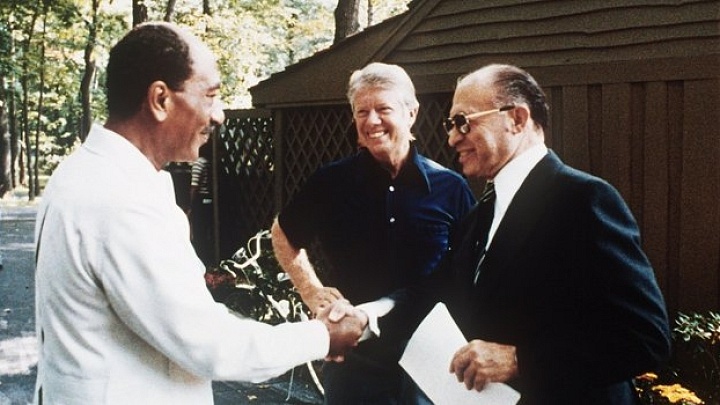
In September 1978, Jimmy Carter, Anwar Sadat, and Menachem Begin brought their multiple narratives to a diplomatic summit. Wright’s gripping account reveals the history, drama, promise, and tragedy of those fateful thirteen days. In his book, the author depicts those multiple narratives and how Sadat and Begin haltingly moved toward pluralism. The foundation of diverse, democratic societies, pluralism is a scarce commodity in the Middle East. Indeed, Sunni Islam’s demographic, political, and social domination of the region has bequeathed a society profoundly hostile to engagement, encounter, and dialogue with alternative worldviews.
The Middle East is a complicated and diverse region. Americans, however, don’t care. Jimmy Carter risked his presidency for peace due to his interest in the Holy Land. The Holy Land happens to also feature the Middle East’s most nagging geopolitical problem: the Israeli-Palestinian conflict. The State of Israel’s creation spawned a nasty, ongoing war over real estate dear to each branch of the Abrahamic faith. In the process of creating a state, the Israelies unwittingly spawned secular terror, the PLO, religious nihilism, al-Qaeda, ISIS, and an Arab-Israeli conflict that has frozen the region’s geopolitics in 1948.
To Wright, an Israeli-Palestinian accord remains the keystone to solving the region’s turmoil. In this way, the author understands the region from a very American perspective. To be sure, ending this conflict would surely solve many of the Middle East’s woes. But the long war that is the Israeli-Palestinian conflict is just as much symptom than cause. The region’s fundamental hostility to pluralism, not the Israeli-Palestinian Conflict, accounts for many of its developmental woes.
Though Wright overestimates the Israeli-Palestinian conflict’s importance, Thirteen Days in September remains an important book. The Camp David Accord’s basic narrative has been told many times before, but not in such a masterful way. Using the thirteen days of Camp David peace talks as his work’s narrative spine, Wright devotes one chapter to each day. In this way, he carries the reader back into September 1978.
Never is the recognition of narrative history’s falsehood and utter necessity more pertinent than in the context of the Israeli-Palestinian conflict. Both sides incessantly proclaim the existence of “multiple narratives.”
This is not a blow-by-blow account of the peacemaking process. Writing in the grand tradition of master historical narratives, Wright details the major players. In the midst of his chronological account, he launches into asides in which he gives historical background to the region’s geopolitics and the biographies of Carter, Begin, Sadat and their respective aides. Through this, the author recreates for the reader the hermetically sealed world that was Camp David in September 1978 — a world in which each major player brought their own history and versions thereof to the negotiating table.
A masterful storyteller, Wright employs his clever 13-day narrative device for more than aesthetic reasons. He rightly considers the accords, for all of their shortcomings, a remarkable achievement in peacemaking. By myopically focusing upon those days, he argues and proves, that peace is achieved by human beings, “prejudiced by their backgrounds, hampered by domestic politics, and blinded by their beliefs.”
Rightfully pilloried for a lackluster presidency, in this book Carter emerges as a farsighted peacemaker. Indeed, Wright credits the president’s very political weakness, a fixation on minutiae, for ensuring success at Camp David. With laser focus and bulldog intensity, the president cajoled, threatened, begged, and otherwise prodded Begin and Sadat into a peace deal both desired but could not achieve on their own.
Largely forgotten by history and obscured by a cavalcade of feckless successors, Anwar Sadat comes to life. In Wright’s lively prose, Sadat reemerges as a gambling, impulsive, far-sighted, and ultimately heroic figure. Out to displace Israel as America’s primary ally in the region, Sadat came to Camp David with a sophisticated geopolitical strategy and a negotiating team united in their opposition to the accords. If Carter deserves “gold,” then, to the author, Sadat warrants the “silver” for his ability to overcome history and choose peace.
Of the three, Begin emerges as the most tortured leader. Wright paints the painful portrait of a young Polish Jew who endured a cruel, anti-Semitic society and by an accident of history escaped the Holocaust. As an adult, Begin emerged from the ranks of a shadowy and vaguely anti-Arab Irgun to found the right wing Likud Party and become the first non-Labour Prime Minister of Israel. Surrounded by aides less burdened by the past, Begin grudgingly and haltingly yielded to Carter’s threats and demands and signed the Accords.
Thirteen Days in September is timely. It is a prescription for peacemaking. An end to the Israeli-Palestinian conflict has never seen so remote. Wright’s work stands as an explicit reminder that peace is possible through unyielding American leadership and an Arab and Israeli willingness to embrace pluralism.
[Photo: AFP/Getty Images]
Thirteen Days in September: Carter, Begin, and Sadat at Camp David
by Lawrence Wright
Alfred A. Knopf, 368 pages. $27.95 (cloth)
Jeffrey Bloodworth is an associate professor of history at Gannon University. He is the author of The Wilderness Years: A History of American Liberalism, 1968-1992.


Pierre Bienaime reviews Andrew Cockburn's new book, Kill Chain: The Rise of the High-Tech Assassins, which questions the efficacy of drones in warfare.

UC Berkeley's Jason Klocek reviews Karen Armstrong's Fields of Blood: Religion and the History of Violence in which she seeks to systematically debunk the...
Arnold Isaacs reviews Nazila Fathi's new memoir, The Lonely War: One Woman's Account of the Struggle for Modern Iran, in which she explores the Islamic...


One Comment